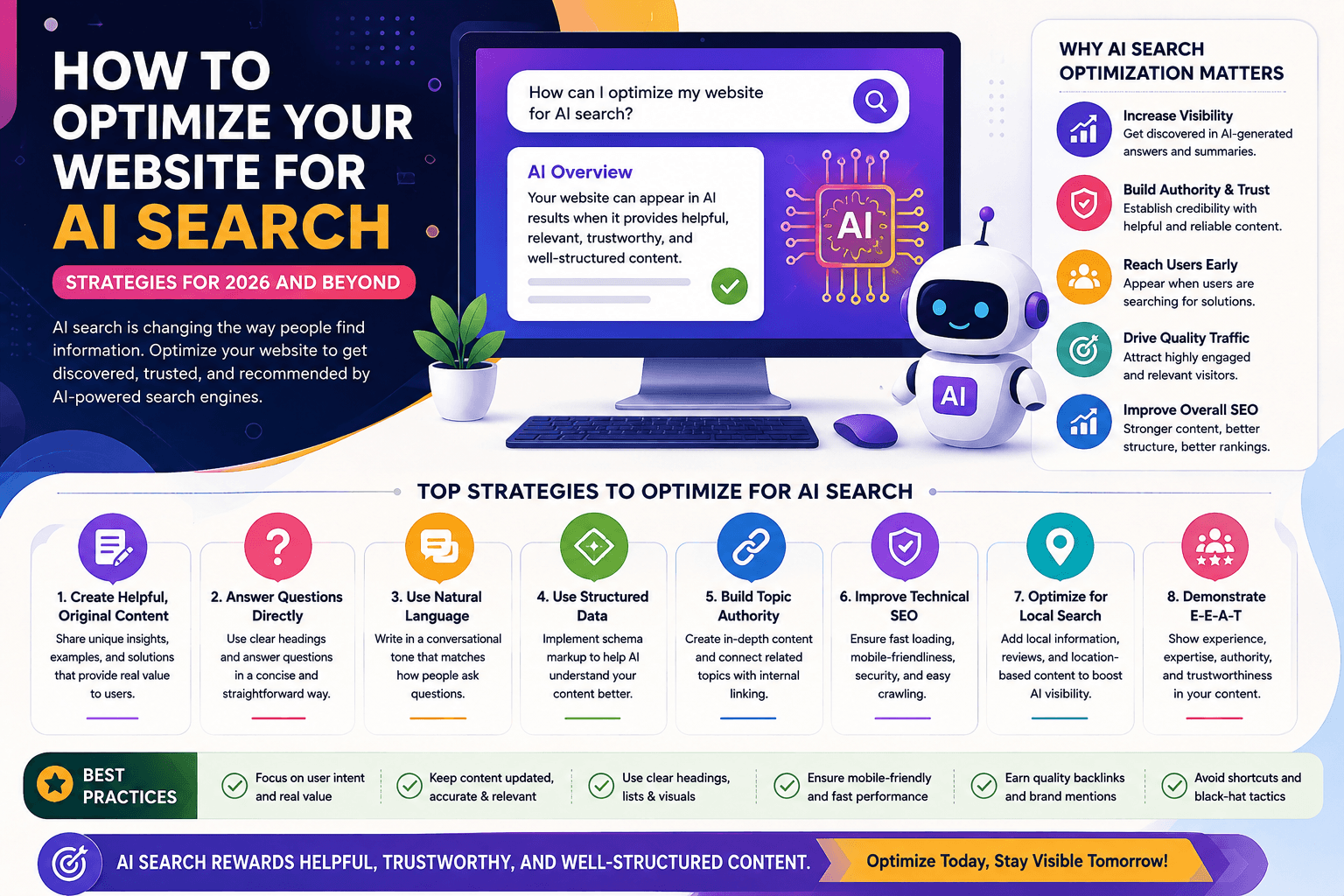
Optimize Your Website for AI Search in 2026: Search is changing rapidly. People are no longer relying only on traditional search results to find information. AI-powered search experiences can understand questions, summarize information, compare options, and provide direct answers.
For businesses, this creates a new opportunity: your website needs to be discoverable not only by traditional search engines but also by AI-powered search and answer engines.
In 2026, SEO increasingly involves creating content that is useful to people, easy for search engines to understand, and structured clearly enough for AI systems to identify relevant information.
This is where AI SEO, Answer Engine Optimization (AEO), and Generative Engine Optimization (GEO) come into play.
What Is AI Search?
AI search uses artificial intelligence to understand a user’s intent and provide more direct, contextual answers.
Instead of simply displaying a list of links, AI-powered search can synthesize information from multiple sources and present an answer.
Users may ask questions such as
- “What is the best website platform for a small business?”
- “How much does website development cost?”
- “Which SEO strategy should a local business use?”
- “What are the benefits of website maintenance?”
This means businesses need content that clearly answers real questions.
Why AI Search Optimization Matters in 2026
Traditional SEO remains important, but the search journey is becoming more conversational and answer-focused.
Optimizing for AI search can help businesses:
- Increase online visibility
- Build brand authority
- Reach users during informational searches
- Improve chances of enhancing the likelihood of AI-generated answers referencing your content. by AI-generated answers
- Generate qualified website traffic
- Strengthen overall SEO performance
The goal should not be to create content specifically for machines. Instead, businesses should create high-quality, trustworthy, well-structured content that AI systems can understand and users find genuinely useful.
1. Create Helpful, Original Content
One of the most important AI search optimization strategies is creating useful content that provides genuine value.
Avoid publishing pages that simply repeat information already available elsewhere.
Instead, provide:
- Original insights
- Practical examples
- Expert explanations
- Relevant statistics
- Step-by-step solutions
- Frequently asked questions
- Real-world experience
For example, instead of writing a generic article titled “What Is SEO?”, create a more useful resource such as
“How Local Businesses Can Improve SEO: A Step-by-Step Guide for 2026.”
Specific, useful content gives both users and search systems more context about your expertise.
2. Answer Questions Directly
AI search is designed to understand questions and provide answers.
Structure your content around the questions your customers actually ask.
Use headings such as
What Is AI Search?
How Does AI Search Work?
How Can Businesses Optimize for AI Search?
Does Traditional SEO Still Matter?
Please provide a concise answer immediately after each question, followed by additional detail.
This structure makes your content easier to scan and understand.
3. Use Conversational and Natural Language
People often interact with AI search using complete questions rather than short keywords.
Instead of focusing exclusively on:
“website maintenance”
Also consider natural-language searches such as
“Why is website maintenance important for a business?”
“How often should a business update its website?”
“What does website maintenance include?”
Use natural language throughout your content without unnecessarily repeating keywords.
4. Build Strong Topic Authority
One article is usually not enough to establish authority around a competitive topic.
Create a group of related articles covering different aspects of the subject.
For example, a website development company could create:
- Website Development Guide for Businesses
- Website Redesign Checklist
- Website Maintenance Guide
- Website Speed Optimization Guide
- Mobile-First Web Design
- AI-Powered Website Development
- Website SEO Checklist
- AI Search Optimization Guide
These interconnected resources create a stronger topical structure.
5. Demonstrate Experience and Expertise
Trust is increasingly important in search.
Your website should clearly communicate:
- Who created the content?
- Your company’s expertise
- Relevant experience
- Services and capabilities
- Contact information
- Business information
- Author information where appropriate
Add an About Us page and author or expert information where it genuinely helps establish credibility.
For business websites, case studies and examples can also demonstrate practical experience.
6. Improve Your Website’s Technical SEO
AI search optimization does not replace technical SEO.
Your website should have a strong technical foundation.
Focus on:
- Fast loading times
- Mobile responsiveness
- HTTPS security
- Crawlable pages
- Clean URLs
- Proper internal linking
- XML sitemap
- Appropriate robots.txt configuration
- Canonical URLs
- Descriptive page titles
- Optimized meta descriptions
A technically accessible website makes it easier for search systems to discover and understand your content.
7. Use Structured Data
Structured data helps search engines understand the meaning and context of your pages.
Depending on your content, relevant schema types may include:
- Article
- Organization
- Local Business
- Product
- Service
- FAQPage
- BreadcrumbList
- Event
Use structured data only when it accurately represents the visible content on the page.
It should support your SEO strategy rather than be treated as a shortcut to AI visibility.
8. Strengthen Internal Linking
Internal links help connect related information across your website.
For example, an article about AI search optimization could link to:
- SEO services
- Website development
- Website maintenance
- Content marketing
- Local SEO
- Website redesign
Use descriptive anchor text so users and search engines can understand what the linked page is about.
9. Create Clear FAQ Sections
FAQ sections can address specific questions users have about your products, services, or topics.
For example:
What is AI SEO?
AI SEO refers to optimizing a website and its content so it can be effectively discovered, understood, and represented across AI-powered search experiences.
Does AI search replace Google SEO?
No. Traditional SEO remains important because AI-powered search experiences can still rely on web content and established search infrastructure.
How can a small business prepare for AI search?
A small business can focus on helpful content, technical SEO, clear business information, structured data, strong internal linking, and demonstrating genuine expertise.
Keep FAQs useful and relevant rather than adding questions simply to target keywords.
10. Optimize for Local AI Search
Local businesses have another major opportunity.
Make sure your website clearly communicates:
- Business name
- Services
- Location
- Contact details
- Opening hours
- Service areas
- Customer reviews
- Business credentials
Create useful location-specific content rather than producing large numbers of nearly identical city pages.
For example:
“Website Development Services for Your Businesses”
is more useful when it provides genuinely local information, examples, services, and customer value rather than simply repeating the city name.
11. Keep Business Information Consistent
Make sure important information is consistent across your website and legitimate business profiles.
Check:
- Business name
- Address
- Phone number
- Website
- Services
- Business category
Consistent information helps users and search systems understand your business more accurately.
12. Update Important Content Regularly
AI search optimization is not a one-time activity.
Review important pages periodically to ensure:
- Statistics are current.
- Links still work
- Examples remain relevant.
- Services are accurate.
- Outdated information is removed.
- New developments are included.
Don’t change dates or wording simply to make old content appear fresh. Updates should provide genuine improvements.
13. Focus on Search Intent
Keywords alone aren’t enough.
Understand why someone is searching.
For example:
“website development cost” → Commercial investigation
“How to build a business website” → Informational
“website development company near me” → Local/commercial
Your content should match the user’s intent instead of forcing the same keyword into every section.
14. Earn Mentions and Quality Links
Authority still matters.
Build your website’s reputation through legitimate methods such as
- Industry publications
- Relevant business directories
- Partnerships
- Digital PR
- Original research
- Expert contributions
- High-quality back-links
Avoid buying large quantities of low-quality links or using automated link-building schemes.
Quality and relevance matter more than simply collecting links.
15. Don’t Forget Traditional SEO
One of the biggest mistakes businesses can make is treating AI SEO as a replacement for traditional SEO.
A strong AI search strategy should build on fundamental SEO:
Technical SEO + Helpful Content + Authority + Structured Data + User Experience + Clear Business Information
Instead of choosing between SEO and AI search optimization, integrate them into one strategy.
AI Search Optimization vs. Traditional SEO
Traditional SEO AI Search Optimization Targets keywords, target questions, and intent. Focuses on rankings Focuses on visibility in AI answers Optimizes pages Optimizes information and context Uses internal links Builds connected topic coverage Focuses on search traffic Focuses on discovery and qualified visibility Technical SEO + machine-readable context Content optimization: Helpful, authoritative answers
These strategies overlap significantly. A well-optimized website can benefit from both.
Common AI SEO Mistakes to Avoid
❌ Keyword Stuffing
Repeating keywords excessively can make content difficult to read.
❌ Publishing AI-Generated Content Without Review
Automatically generated content can contain errors, outdated information, or generic statements.
❌ Creating Content Only for Search Engines
Content should solve real customer problems.
❌ Using Fake Expertise
Don’t create artificial credentials, reviews, case studies, or claims.
❌ Ignoring Technical SEO
Great content cannot perform well if important pages cannot be properly accessed or understood.
❌ Chasing Every New AI Trend
Focus on fundamentals that provide lasting value rather than short-term tricks.
AI Search Optimization Checklist for 2026
Before publishing a page, ask:
☑ Does it answer a genuine user question?
☑ Is the information accurate and useful?
☑ Does the content demonstrate expertise?
☑ Are headings clear and descriptive?
☑ Are important answers easy to find?
☑ Is the website mobile-friendly?
☑ Does the page load quickly?
☑ Are internal links relevant?
☑ Is structured data implemented appropriately?
☑ Are business details clear and consistent?
☑ Is the content original and genuinely helpful?
☑ Are outdated claims and links regularly reviewed?
Final Thoughts
AI is changing how people discover information online, but the fundamentals of good SEO remain highly relevant.
Businesses that want to succeed in AI search should focus on helpful content, clear answers, technical accessibility, strong expertise, structured information, and an excellent user experience.
Rather than trying to “hack” AI search, build a website that deserves to be discovered.
In 2026, the best AI search strategy is simple: be useful, be trustworthy, and make your information easy to understand.
For additional information, go to www.soltervision.com, our website. You can email us at Email Us.