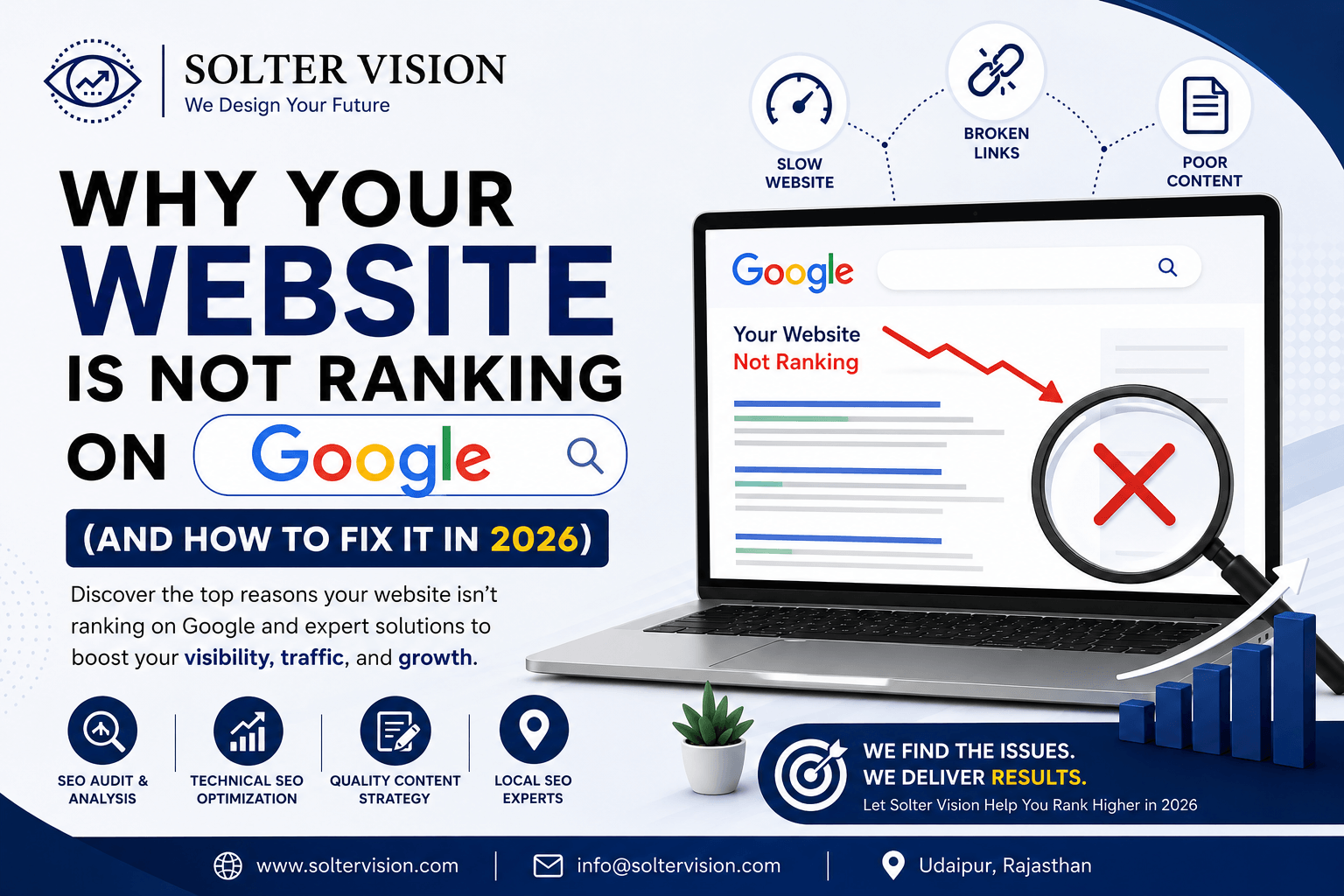
Every business owner asks the same question at some point:
“Why isn’t my website showing up on Google?”
You’ve invested time and money into your website, published content, and maybe even hired someone for SEO—but your competitors still appear above you.
The truth is that Google’s ranking algorithms have become smarter than ever in 2026. Simply having a website is no longer enough. Your website must provide an excellent user experience, high-quality content, technical excellence, and genuine authority.
At Solter Vision, we’ve helped businesses improve their online visibility by identifying hidden SEO problems and implementing strategies that actually work.
Let’s explore the most common reasons your website isn’t ranking—and how to fix them.
1. Your Website Isn’t Properly Indexed
Before your website can rank, Google must first discover and index it.
Many websites unknowingly block search engines through:
- Incorrect robots.txt settings
- Noindex tags
- Missing XML sitemap
- Crawl errors
- Broken internal links
How to Fix It
- Submit your XML sitemap through Google Search Console.
- Check Index Coverage regularly.
- Remove accidental “Noindex” tags.
- Fix crawl and indexing errors.
Without indexing, your pages simply cannot appear in search results.
2. You’re Targeting the Wrong Keywords
One of the biggest SEO mistakes is trying to rank for keywords that are either:
- Too competitive
- Irrelevant
- Have no search volume
Instead, focus on keywords your customers actually search.
Example:
Instead of
Website Company
Target
Best Website Development Company in Udaipur
or
Affordable SEO Services for Small Businesses
Long-tail keywords usually generate higher-quality traffic.
3. Your Website Loads Too Slowly
Google considers page speed a ranking factor.
Slow websites increase bounce rates and reduce conversions.
Common causes include:
- Large images
- Poor hosting
- Excessive plugins
- Unoptimized code
- Uncompressed files
Speed Optimization Tips
- Compress images
- Use modern image formats
- Enable browser caching
- Minify CSS and JavaScript
- Upgrade to reliable hosting
- Use a CDN
Fast websites improve both rankings and user experience.
4. Your Website Isn’t Mobile-Friendly
Over 70% of searches now happen on mobile devices.
If your website isn’t responsive:
- Visitors leave quickly
- Google lowers your rankings
- Conversion rates drop
A mobile-friendly website should feature:
- Responsive design
- Fast loading
- Easy navigation
- Readable fonts
- Clickable buttons
5. Poor Quality Content
Google rewards helpful, original, and well-structured content.
Many websites publish:
- Thin content
- Duplicate articles
- AI-generated content without human editing
- Outdated information
- Keyword-stuffed pages
Instead, create content that genuinely answers users’ questions.
Every blog should include:
- Clear headings
- Practical advice
- Original insights
- Updated information
- Relevant images
- Internal links
Quality always outperforms quantity.
6. Missing On-Page SEO
Even excellent content won’t rank if it’s poorly optimized.
Check whether your pages include:
- SEO-friendly titles
- Meta descriptions
- H1 and H2 headings
- Image ALT tags
- Internal linking
- Clean URLs
- Keyword placement
On-page SEO helps Google understand your content.
7. Weak Technical SEO
Technical SEO is the foundation of search visibility.
Common issues include:
- Broken links
- Redirect chains
- Duplicate pages
- Missing canonical tags
- Schema errors
- HTTPS issues
Technical audits often uncover problems that prevent strong rankings.
8. No High-Quality Back-links
Back-links remain one of Google’s strongest ranking signals.
However, quality matters far more than quantity.
Earn links through:
- Guest blogging
- Industry partnerships
- Digital PR
- Helpful resources
- Original research
- Shareable content
Avoid buying low-quality back-links, as they can harm your rankings.
9. Ignoring Local SEO
If you serve customers in a specific area, local SEO is essential.
Optimize your:
- Google Business Profile
- Business citations
- NAP consistency (Name, Address, Phone)
- Customer reviews
- Location pages
- Local keywords
For example:
Instead of
Website Development Company
Use
Website Development Company in (Location)
This helps attract customers searching nearby.
10. You’re Expecting Results Too Quickly
SEO isn’t an overnight strategy.
Google needs time to:
- Crawl your pages
- Evaluate your content
- Build trust
- Measure user engagement
Most websites begin seeing meaningful improvements within 3–6 months, depending on competition, website quality, and SEO consistency.
Patience and consistent optimization are key to long-term success.
SEO Checklist for 2026
Before expecting higher rankings, make sure your website has:
✅ Mobile-friendly design
✅ Fast loading speed
✅ HTTPS security
✅ Proper keyword research
✅ High-quality content
✅ XML sitemap
✅ Google Search Console
✅ Google Analytics
✅ Internal linking
✅ Optimized images
✅ Meta titles & descriptions
✅ Schema markup
✅ Local SEO optimization
✅ Quality backlinks
✅ Regular content updates
How Solter Vision Helps Businesses Rank Higher
At Solter Vision, we provide comprehensive SEO services designed to improve your website’s performance in search results.
Our SEO solutions include:
- Comprehensive Website SEO Audit
- Keyword Research & Strategy
- Technical SEO Optimization
- On-Page SEO
- Local SEO
- Google Business Profile Optimization
- Content Strategy
- Monthly Performance Reports
- Website Speed Optimization
- Ongoing SEO Maintenance
Our goal is not just to increase rankings but to drive qualified traffic that leads to real business growth.
Final Thoughts
If your website isn’t ranking on Google, don’t assume SEO doesn’t work. In most cases, there are identifiable issues holding your site back—from technical problems and slow performance to weak content and poor keyword targeting.
By addressing these areas consistently, you can improve your visibility, attract more qualified visitors, and generate more leads over time.
If you’re looking for expert guidance, Solter Vision can help you audit your website, resolve SEO issues, and build a strategy that delivers sustainable growth in 2026.
FAQs
Why is my website not appearing on Google?
Common reasons include indexing issues, poor SEO, slow loading speed, weak content, technical errors, or targeting the wrong keywords.
How long does SEO take in 2026?
Most websites start seeing noticeable improvements within 3–6 months, though timelines vary by competition and website quality.
Does website speed affect Google rankings?
Yes. Faster websites generally provide a better user experience, which can positively influence search rankings.
Can Solter Vision help improve my Google rankings?
Yes. Solter Vision offers SEO audits, technical optimization, on-page SEO, local SEO, keyword research, and ongoing optimization to help businesses improve their online visibility.
For additional information, go to www.soltervision.com, our website. You can email us at Email Us.